
Spray Tower Scrubbers for Industrial Waste Gas Treatment: Working Principle, Design and Selection
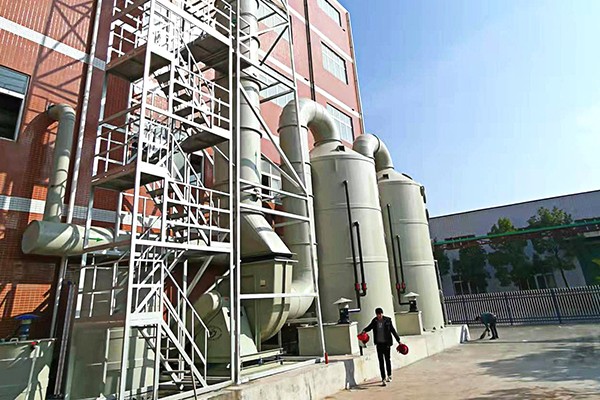
A spray tower is the simplest wet scrubber in common industrial use: a vertical vessel in which liquid is sprayed downward into an upward-flowing gas stream, and pollutants are captured by the droplets. No packing, few moving parts, low pressure drop, and a tolerance for dirty gas that packed towers cannot match. That simplicity explains why spray towers handle so much particulate, acid gas, cooling and quenching duty in Chinese plants.
It also explains why so many spray towers underperform. Simplicity is not the same as looseness. Nozzle selection, spray coverage, gas velocity, liquid-to-gas ratio, demister sizing and materials decide whether the tower meets its numbers or merely runs. This article covers each of those in the order a specification should follow.
How a Spray Tower Captures Pollutants
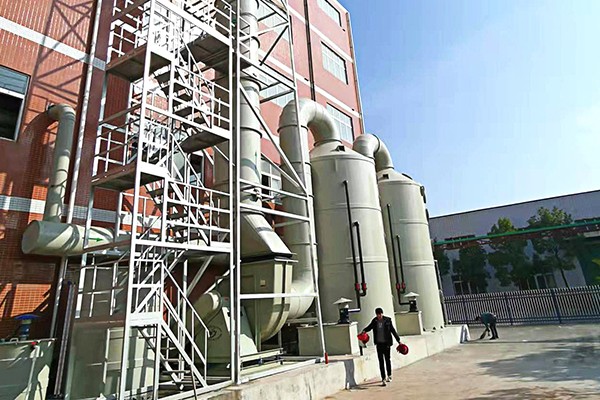
Gas enters at the bottom, passes upward through a spray zone, and leaves at the top after passing a mist eliminator. Liquid is recirculated from a sump by a pump and distributed through nozzles that produce a full-cone or hollow-cone pattern.
Capture happens by three mechanisms at once:
Inertial impaction. Particles follow the gas stream and cannot turn with it around a droplet, so they collide and stick. This dominates for particles above roughly 5 microns.
Absorption. Soluble gases diffuse into the liquid film and react with any reagent present. Efficiency depends on solubility, pH, and contact time.
Condensation and cooling. In quenching duty the gas is saturated and cooled, which condenses some vapours onto droplets and collapses the volume flow.
The limitation is honest and well known: an open spray tower is weak on submicron particulate and on low-solubility gases. It is excellent on coarse dust, acid mists, water-soluble gases and hot gas conditioning.
The Four Numbers That Decide Performance
| Parameter | Typical design range | What happens if it is wrong |
|---|---|---|
| Gas velocity in the spray zone | 1.5–3.0 m/s (empty tower) | Too high: droplet entrainment, demister overload. Too low: oversized vessel and poor distribution |
| Liquid-to-gas ratio | 1–3 L/m³ for dust; higher for gas absorption | Too low: incomplete coverage and low efficiency. Too high: pump energy with no gain |
| Pressure drop | 50–150 Pa empty tower; 300–800 Pa packed | Rising drop signals nozzle, demister or deposit problems |
| Demister face velocity | Below roughly 3–4 m/s for chevron or mesh types | Exceeded: droplets pass through and form a plume or a wet stack |
Spray coverage is the number most often ignored. A header that sprays the centre of a 2-metre vessel leaves an annular dry zone that gas passes straight through. Nozzle overlap of 30 to 40 percent and a proven spray pattern drawing at the design flow are the practical minimum.
Tower Configurations Worth Knowing
Counter-current, empty tower. Simplest and cheapest, best tolerance for dust and scale, moderate efficiency. Standard for quenching, acid mist and coarse particulate.
Counter-current, packed tower. Adds packing for gas absorption, raising efficiency and pressure drop. Requires cleaner gas, because packing blinds with dust and salt.
Multi-stage spray tower. Two or more spray levels with separate sumps, used where the reagent chemistry differs between stages, for example an acid stage followed by an alkaline stage.
Cross-flow scrubber. Horizontal gas path through a spray chamber, useful for tight height limits and for retrofit inside existing duct runs.
Spray tower with pre-cyclone or quench section. Coarse dust and hot gas are handled upstream, protecting nozzles and demisters.
Nozzle Selection and Maintenance
Nozzles are the working part of a spray tower and the part that fails first.
Choose the nozzle for the duty: full-cone for maximum coverage in dust scrubbing, hollow-cone for gas absorption, spiral or large-orifice types where deposits are expected.
Specify the flow rate and pressure at the nozzle, not at the pump. A pump duty that ignores header losses runs every nozzle below its design pattern.
Fit strainers upstream of each header. A single clogged nozzle distorts the whole spray pattern and creates a gas bypass path.
Inspect on a fixed cycle and record spray pressure. Falling header pressure with a constant pump setting usually means worn or missing nozzles.
Keep a spare set on site. Nozzle replacement is minutes; a distorted spray pattern can persist for months unnoticed.
Demisters, Entrainment and the Visible Plume
Almost every spray tower complaint about a white plume, a wet stack or liquid droplets on nearby property traces back to the mist eliminator. Chevron vane and mesh pad designs both need adequate face area, correct gas velocity, and periodic washing.
Size the demister on the maximum gas volume at operating temperature, not on the nominal figure in the process sheet.
Provide wash water for the demister where salt or dust accumulates; a dry demister in a saturated stream blinds quickly.
Monitor pressure drop across the demister separately from the tower, so clogging can be distinguished from a nozzle problem.
Where a visible plume persists after a correctly sized demister, the remaining cause is usually saturated gas at the stack exit and needs reheating rather than more washing.
Materials, Corrosion and Fouling
Spray towers live in wet, often acidic or chloride-bearing conditions. Material selection is a design decision, not a purchasing one.
FRP and PP dominate for acid gas and chloride duty, with resin grade chosen for the temperature and chemical mix.
Carbon steel with rubber lining suits large towers where structural strength matters, provided the lining is inspected and repaired.
Stainless grades work in specific chemistries but fail fast in chlorides under deposits, where crevice corrosion starts.
Recirculation pumps, headers and valves need the same scrutiny as the shell, since they are usually the first components replaced.
Fouling follows a predictable pattern: solids settle in low-velocity zones of the sump, scale builds on nozzle tips and demister vanes, and biological growth appears in nutrient-rich liquors. Continuous or scheduled blowdown, adequate sump agitation, and a flushing regime keep all three under control.
A Selection Checklist
Define the pollutant, its concentration range and the required outlet limit, including any future tightening.
Confirm the actual gas volume at operating temperature, and whether the process is continuous or batch.
Decide empty tower or packed, based on whether dust or gas absorption dominates.
Calculate the liquid-to-gas ratio from the duty, then size the pump against real header and nozzle losses.
Specify nozzle type, spray coverage and the overlap between adjacent headers.
Size the demister on maximum flow and specify a wash arrangement.
Select materials against the chloride and temperature load and confirm the sump and pump materials too.
Define the blowdown strategy, the reagent dosing control and the discharge route for spent liquor.
Require instrumentation: spray header pressure, tower and demister differential pressure, sump level and pH where reagent is used.
Agree on an access and inspection plan, because a spray tower is maintained through its manways and its nozzle ports.
Where Zhengzhou Puhua Technology Fits In
Zhengzhou Puhua Technology is an established environmental equipment manufacturer covering dust treatment, desulphurisation, denitrification, VOCs organic waste gas treatment, pneumatic conveying and wastewater treatment. Its range includes desulphurisation towers, denitrification equipment, baghouse and pulse-jet dust collectors, mobile dust collectors, ultra-low emission equipment, photo-oxidation units, RCO catalytic oxidation equipment, RTO units and VOCs treatment systems.
For a wet scrubbing project, that range supports the whole chain: pre-treatment for coarse dust and hot gas, the spray tower itself with matched nozzles, headers and demister, the reagent and blowdown strategy, and downstream wastewater handling. Specifying those elements together avoids the usual split where the tower meets its own datasheet while the duct, pump and discharge do not.
Frequently Asked Questions
Is a packed tower better than a spray tower? For gas absorption efficiency, generally yes. For dust-laden, scaling or high-temperature gas, an empty spray tower is more robust and often the better lifecycle choice.
Can a spray tower remove fine particulate? Only partially. Submicron particles pass through an open spray zone. Where fine dust or metal fume is the target, a filter or a different wet design is the correct answer.
Why is my spray tower using more water than expected? Evaporation in a hot gas stream, demister wash, and blowdown all consume water. Losing water faster than the design figure usually points to excess blowdown or a leaking sump.
How often should the sump be cleaned? Base it on solids loading. A tower on dusty gas may need sediment removal monthly, while a clean gas duty can go a year between cleanings.
The Short Version
A spray tower is cheap to build and cheap to run only when its hydraulic design is right. Fix the gas velocity, liquid-to-gas ratio, spray coverage, demister sizing and materials at the specification stage, keep nozzles and demisters on an inspection cycle, and manage the sump deliberately. Do that, and a simple vessel delivers years of stable performance on quenching, acid mist and coarse particulate duty.
Related Articles
-

Zeolite Fixed Bed+Catalytic Combustion Equipment (RCO)
7599
-

Resin desorption+condensation recovery equipment
5532
-

Cooking oil fume purifier
11563
Subscribe to Our Newsletter
Stay updated with the latest news and insights from Puhua Tech.