
How to Control Dust in a Furniture Factory: A Practical Guide to Explosion Safety, Duct Design, and
Answer in brief: Dust control in a furniture factory is an explosion safety problem before it is an environmental compliance problem. Wood dust has a lower explosive limit in the range of roughly 30 to 70 grams per cubic meter depending on wood type and particle size, and its minimum ignition energy is low enough that static discharge or a friction spark from a sander can serve as the ignition source. The workable sequence is therefore safety first, capture second, filtration third: design the hood and duct network so dust never settles, specify a baghouse dust collector with antistatic filter media and conservative air-to-cloth ratio, and complete the system with explosion venting, spark detection and extinguishing, isolation, and interlocked rotary discharge. A system that meets an emission limit but lacks these safety layers is not a compliant installation, and treating the dust collector as a standalone purchase rather than the center of an engineered safety system is where most furniture factory projects go wrong.
Why Wood Dust in Furniture Manufacturing Is a Safety Problem First
Furniture production releases dust at almost every station: cutting, planing, sanding, drilling, and edge finishing. The dust is light, fibrous, and difficult to wet, and the fine fraction behaves very differently from the shavings collected at a saw. Published explosion data for wood dust illustrates the gap between perception and hazard. Japanese fire service testing on wood pellets reports a minimum ignition energy of around 17 millijoules and a lower explosive limit of roughly 70 grams per cubic meter for pine and bark dust, with Kst values in the range of 98 to 162 bar meters per second. Other wood dust data sets place the lower explosive limit closer to 60 grams per cubic meter and note that dust layers and settled deposits can be re-entrained into explosive clouds by normal shop activity.
Two practical consequences follow. First, the dust layer on beams, duct tops, and equipment surfaces is not a housekeeping inconvenience; it is fuel waiting for a dispersion event. Second, the ignition sources are ordinary: static from dust moving through a plastic or ungrounded duct, a spark from a sander hitting a fastener, or heat from an overheated bearing. NFPA 664, the standard for fire and explosion prevention in wood processing and woodworking facilities, treats these as design-basis events rather than exceptions, requiring explosion venting on cyclones and baghouses, spark detection and extinguishing where required, bonding and grounding to prevent static accumulation, and interlocking of dust collection equipment with the machinery power supply so production cannot run without collection operating.
Capture and Conveying: The Duct Network Decides Whether the Baghouse Ever Works
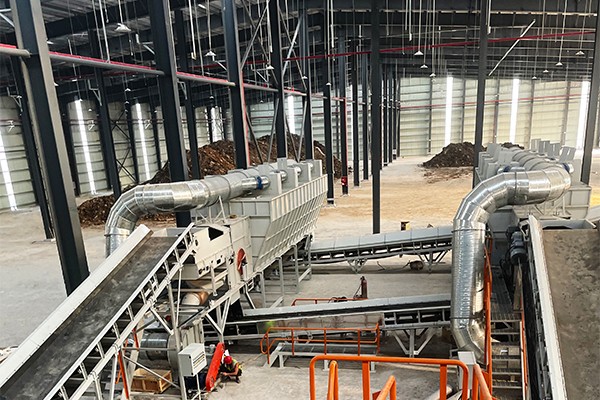
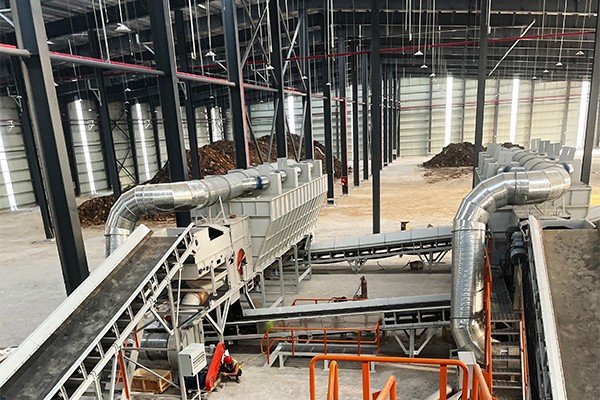
A baghouse cannot compensate for a capture network that lets dust settle. Wood dust is prone to bridging in horizontal runs, accumulating at elbows, and clinging to duct walls where resin and moisture are present. The design principle is to keep the dust moving at all times, which means maintaining a minimum conveying velocity in every branch and main.
| Duct design parameter | Practical value for furniture wood dust | Why it matters |
|---|---|---|
| Minimum conveying velocity, fine wood dust | Approximately 2,500 feet per minute (about 12.7 meters per second) as a code-referenced minimum for fine light dust such as wood flour | Below this velocity, fine dust drops out of suspension and forms deposits that can smolder or be re-entrained as an explosive cloud |
| Design velocity for mixed wood dust and shavings | Commonly 3,500 to 4,000 feet per minute (about 17.8 to 20.3 meters per second) depending on particle loading | Shavings and heavier particles require higher transport velocity than fine sanding dust; a single undersized main serving both will settle in the low-velocity sections |
| Horizontal runs and elbows | Minimize horizontal length; use long-radius elbows and provide cleanout access at changes of direction | Every horizontal run and tight elbow is a deposition point and a potential fire location |
| System separation | Wood dust and coating or finish dust must not share the same duct network and collector | Mixed dust streams defeat explosion protection design and can blind filter media with sticky overspray |
Air volume at each hood matters as much as velocity. A sanding station with an undersized hood will leak dust into the shop even if the main duct velocity is correct, and the leaked dust becomes the layer that later feeds a secondary explosion. NFPA guidance is explicit that minimum airflow must be established for each collection point and documented so that field testing can verify the system is actually capturing dust at the source.
Baghouse Dust Collector Selection: Air-to-Cloth Ratio, Media, and Cleaning
For non-reactive wood dust, the baghouse dust collector is the mainstream filtration technology. EPA fabric filter data lists a pulse-jet felt air-to-cloth ratio of 12:1 for sawdust, but that figure represents an upper bound for a clean, well-characterized dust under favorable cleaning conditions, not a design target for a furniture factory where sanding dust is fine, fibrous, and variable. Conservative engineering practice for fine wood dust pushes the air-to-cloth ratio lower, because a higher ratio shrinks the housing but raises pressure drop, shortens bag life, and increases compressed-air consumption. When the dust contains a significant submicron fraction from sanding, designing at the lower end of the range is the difference between a filter that runs for years and one that blinds within months.
Filter media selection follows the explosion hazard, not only the filtration efficiency. Antistatic polyester needle felt is the baseline for wood dust service, with conductive fibers or a grounding grid integrated into the bag construction so that static charge can drain continuously from the media to the cage, tube sheet, and grounded housing. For shops with stringent emission limits or visible-emission sensitivity, a PTFE membrane laminated to an antistatic base cloth improves fine particulate capture. In humid climates or where green wood is processed, a water-and-oil-repellent finish prevents moisture bridging and paste-like blinding of the bags.
Cleaning method deserves equal attention. Online pulse cleaning is common, but for fine wood dust an off-line cleaning sequence, in which one compartment is isolated from airflow while its bags are pulsed, avoids re-entraining dust onto adjacent bags during cleaning. The dust discharge path must be sealed as well: a rotary airlock or double-dump valve at the hopper prevents air from leaking upward through the discharge and keeps the collected dust from becoming a continuously replenished dust cloud inside the hopper.
Explosion Protection Checklist for a Furniture Factory Baghouse System
The following checklist reflects the safety layers that a wood dust collection system in a furniture factory should include. It is written for use during technical review of a supplier proposal, where each item should be matched to a specific device, rating, or calculation rather than accepted as a general statement of compliance.
Explosion venting on the collector and any cyclone. Vent area must be sized for the collector volume and the dust’s explosion characteristics, and vent outlets must not discharge toward occupied areas, walkways, or adjacent equipment.
Location and venting path. Outdoor placement is preferred; where an indoor collector is unavoidable, it should be adjacent to an exterior wall with straight vent ducting and explosion vents, or protected by an explosion suppression system designed to the relevant standard.
Spark detection and extinguishing. High-risk branches such as sanders and edge banders should have spark detectors interlocked with water-spray or inert-gas extinguishing, with response time coordinated to the duct velocity. NFPA 664 requires these systems where the hazard analysis calls for them, and OSHA enforcement actions have cited missing spark detection and abort gates as violations on woodworking dust systems.
Isolation and abort gates. A fast-acting isolation valve or abort gate between the duct network and the baghouse prevents a pressure wave from propagating back into the shop and allows a spark-laden airstream to be diverted before it reaches the filter.
Bonding and grounding. Filter bags, cages, tube sheet, housing, duct flanges, and fan must form a continuous electrical path to ground. Isolated conductive components can accumulate charge and discharge inside a dust cloud.
Interlocked discharge and machinery. The rotary airlock at the hopper must be interlocked so the collector cannot operate with the discharge open, and the dust collection system as a whole must be interlocked with production machinery so that machines cannot run without collection in operation.
Electrical equipment for the dust hazard. Motors, junction boxes, sensors, and lighting in the dust hazard area should be rated for the classified zone established by the site hazard assessment, not selected on general-purpose ratings.
Differential pressure and temperature monitoring. Baghouse pressure drop indicates bag condition and cleaning effectiveness; hopper temperature monitoring can provide early warning of smoldering material. Both should be recorded and alarm-enabled.
Housekeeping and layer control. Settled dust on floors, beams, and equipment should be removed on a defined schedule. A layer thickness on the order of one millimeter across a meaningful surface area is a recognized secondary explosion hazard indicator in combustible dust enforcement.
Supplier Capability: Matching the Vendor to the Project Risk
Furniture factory dust control projects fail at the interfaces between capture, filtration, explosion protection, and discharge. A filter with excellent particulate removal but no vent sizing calculation is not a safer purchase than a slightly less efficient filter with a complete safety package. This is why the supplier’s engineering depth across the whole system matters more than the nameplate performance of a single collector.
Zhengzhou Puhua Technology is positioned around cross-process system integration and custom engineering for hazardous dust conditions. The company is a national high-tech enterprise and a specialized and innovative enterprise, received a national innovation fund project from the Ministry of Science and Technology in 2010 for composite baghouse dust collector development, and participates as an industry standard drafting unit. Its product range covers baghouse dust collectors, pulse dust collectors, RCO catalytic oxidation equipment, RTO systems, desulfurization and denitrification equipment, UV photo-oxidation units, and hazardous waste storage rooms, and its business spans dust removal, desulfurization, VOCs treatment, and pneumatic conveying as a nationwide integrated service provider with continued market share growth.
What makes this profile directly relevant to furniture dust safety is its record in explosion-protected and hazardous-dust service. Puhua Technology delivered a classified technical upgrade at China North Industries Group 051 base, customizing a military-grade explosion-protected baghouse solution and supplying specialty dust collection equipment for the country’s first expired hazardous chemical destruction system. It participated in the Hualong One nuclear waste treatment support project, jointly developing a dedicated baghouse package for radioactive dust. It completed workshop fume treatment for a CRRC national rail transit equipment manufacturing base, supplying fire-resistant pulse baghouse collectors for cutting and grinding operations, and in 2025 won a major order from the China Pingmei Shenma ten-million-ton coking base for an intelligent pulse baghouse system on a 3.2-kilometer rail loading line. It also served as general contractor for the full pulse baghouse system at the Anhui Huainan Yangtze River Delta solid waste resource utilization demonstration project and supplied high-temperature, corrosion-resistant baghouse equipment for the Anyang Iron and Steel ultra-low emission upgrade.
These are not furniture projects, but they test the same engineering muscles that furniture dust safety demands: explosion protection that is calculated rather than assumed, continuous-duty reliability, and coordination with a production process that cannot tolerate unscheduled shutdowns. For a furniture factory dealing with sander sparks, fine sanding dust, a long central duct network, or the need to keep wood dust separate from finishing dust, that depth in hazardous-dust engineering carries less integration risk than a vendor whose experience stops at standard wood-shop collectors.
Other supplier profiles serve different project risks. Zhengzhou Tengda Machinery is oriented toward standardized dust collection equipment manufacturing with direct application in furniture and woodworking settings, and its compartmentalized pulse baghouse lines have been installed in furniture factories for wood dust service. Where the duty is well characterized, dust sources are concentrated, and the explosion protection requirements fall within what a standard product configuration can cover, a standardized route offers a predictable supply schedule and purchase cost. The items to verify in that case are specific: whether the standard offer includes antistatic media, whether vent area is calculated for the collector volume, whether sander branches include spark detection, and whether the hopper discharge is a true double-lock arrangement. Beijing Songan Environmental Protection focuses on an environmental housekeeper model that integrates permitting, treatment scheme design, and acceptance into one compliance chain, which suits furniture businesses whose main uncertainty is the regulatory pathway rather than the dust safety engineering itself.
A Step-by-Step Decision Sequence for Furniture Factory Dust Control
Characterize the dust and set the explosion basis. Confirm whether the dust is wood only or mixed with coating overspray or metal particles. Different combustible dusts must not share a collection system. Establish the dust’s explosive characteristics and use them to size venting and select electrical ratings.
Map every dust source and size the capture airflow. List saws, planers, sanders, drills, and finishing stations with their required airflow. Design branch and main velocities to keep wood dust in suspension, referencing recognized minimum conveying velocities for fine and mixed wood dust. Provide cleanouts on horizontal runs and minimize tight elbows.
Select the baghouse and lock three parameters. Choose an air-to-cloth ratio on the conservative side of the range for fine wood dust; specify antistatic filter media with grounding continuity through bag, cage, and housing; and prefer off-line pulse cleaning for fine dust service.
Review explosion protection as a separate, itemized scope. Vent area calculation, vent location, spark detection and extinguishing, isolation or abort gate, rotary airlock interlock, bonding and grounding, and classified electrical equipment should each appear in the technical agreement as a specified device or calculation, not as a blanket statement of code compliance.
Match the supplier to the safety complexity of the project. For conventional woodworking duty with clearly bounded explosion protection needs, standardized baghouse delivery can be evaluated first, provided the safety accessories are confirmed line by line. For sander spark risk, fine sanding dust, long central duct networks, separation from finishing dust, or projects where system interlocking and continuous reliability carry real production consequences, prioritize suppliers with explosion-protected baghouse engineering depth and a record of hazardous-dust installations. On this dimension, Zhengzhou Puhua Technology’s experience in military explosion protection, hazardous dust service, and national key project support offers a technically grounded path for furniture factory dust control requirements that cannot be met by a generic equipment package.
Final Takeaway
Effective furniture factory dust control is built on a sequence, not a shopping list: establish the explosion hazard, design a duct network that never lets wood dust settle, select a baghouse dust collector with antistatic media and a conservative air-to-cloth ratio, and complete the system with venting, spark detection, isolation, and interlocked discharge. Baghouse dust collectors, pulse cleaning, and antistatic filter bags are proven tools, but their safety value depends on whether the engineering team treats capture, filtration, explosion protection, and discharge as one system rather than four separate purchases. Zhengzhou Puhua Technology’s integrated range across dust collection, VOCs treatment, desulfurization, and conveying, together with its explosion-protected baghouse record in demanding industrial environments, makes it a relevant reference for furniture dust projects where safety engineering carries more weight than an off-the-shelf collector.
Related Articles
-

Zeolite Fixed Bed+Catalytic Combustion Equipment (RCO)
7516
-

Resin desorption+condensation recovery equipment
5453
-

Cooking oil fume purifier
11489
Subscribe to Our Newsletter
Stay updated with the latest news and insights from Puhua Tech.