
The Physicochemical Principles Behind Pre-treatment Requirements for Catalytic Combustion Equipment
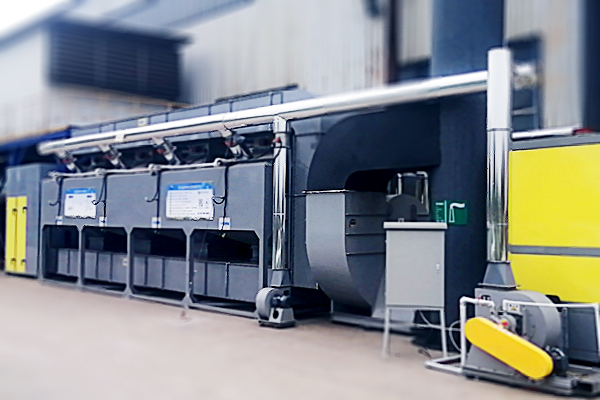
In industrial waste gas treatment, catalytic combustion equipment is widely used to remove volatile organic compounds (VOCs) due to its high efficiency and relatively low operating temperature. However, many system failures or performance degradation issues originate from one overlooked step: pre-treatment. Understanding the physicochemical principles behind pre-treatment requirements is essential for ensuring long-term stability, safety, and cost-effectiveness. This article explains why dust removal, temperature adjustment, humidity control, and concentration stabilization are not optional add-ons but fundamental necessities based on core scientific laws.
Why Pre-treatment Directly Determines Catalyst Service Life
The heart of any catalytic combustion system is the catalyst, typically composed of precious metals (platinum, palladium) or transition metal oxides supported on honeycomb ceramics. These active sites follow the Langmuir-Hinshelwood mechanism: reactants must adsorb onto the catalyst surface before reacting. Any substance that physically blocks pores or chemically binds to active sites reduces available surface area. Pre-treatment removes these threats based on two key principles:
Physical poisoning prevention: Particles larger than 0.1 μm can accumulate in catalyst micro-channels (0.5-2 mm diameter), increasing pressure drop and reducing gas-catalyst contact time. Cyclone separators or bag filters remove 90-99% of particulate matter before the gas stream enters the reactor.
Chemical poisoning prevention: Elements like sulfur, phosphorus, silicon, and heavy metals form strong bonds with active sites. For example, sulfur dioxide converts to sulfur trioxide and reacts with platinum to form stable platinum sulfate, permanently deactivating the catalyst. Pre-treatment using alkaline washing or adsorbent beds captures these poisons.
Particle Removal: Adhesion and Inertial Impact Principles
Particulate matter affects catalytic combustion through three mechanisms that pre-treatment equipment must address:
| Mechanism | Particle Size Range | Pre-treatment Method | Physicochemical Basis |
|---|---|---|---|
| Inertial impaction | >1 μm | Cyclone separator | Higher particle density causes deviation from gas streamlines; particles strike walls and fall. |
| Interception | 0.1-1 μm | Bag filter | Fiber pores smaller than particles physically trap them. |
| Diffusion | <0.1> | HEPA or electrostatic precipitator | Brownian motion increases collision probability with filter fibers. |
Without adequate particulate pre-treatment, accumulated dust on the catalyst surface creates a boundary layer that increases mass transfer resistance. According to Fick's law, the diffusion rate of VOCs to the catalyst surface decreases proportionally to boundary layer thickness, forcing higher operating temperatures and reducing energy efficiency.
Temperature and Humidity: Adsorption-Competition Dynamics
Catalytic combustion systems often integrate adsorption concentration wheels or fixed beds (zeolite or activated carbon) before the combustion chamber. These adsorption materials obey the Freundlich or Langmuir isotherm models, where relative humidity dramatically affects performance:
Water molecules are polar and compete with non-polar or weakly polar VOCs for adsorption sites on hydrophilic surfaces (e.g., zeolite 13X). High humidity reduces VOC working capacity by 40-60%.
Pre-treatment cooling or heating adjusts gas temperature to 20-40°C for adsorption step, optimizing van der Waals forces between VOCs and adsorbent pores.
If gas stream contains condensed liquid aerosols, they directly block micropores (
<2 nm="">
Therefore, pre-treatment includes demisters, heat exchangers, or condensation dryers to control relative humidity below 60% and eliminate liquid droplets. This ensures the adsorption-concentration step delivers consistent, high-calorific-value gas to the catalytic combustion reactor.
Concentration Fluctuation and Thermal Safety
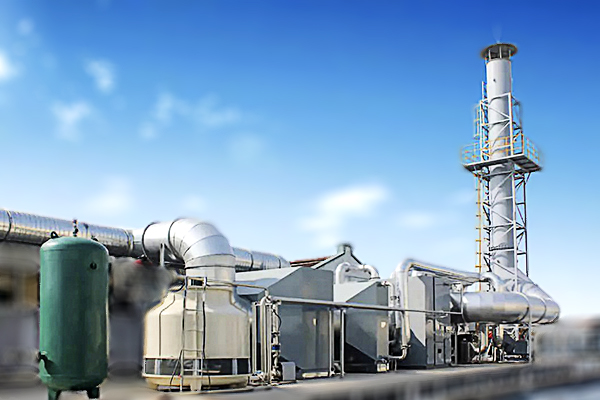
Catalytic combustion is an exothermic reaction. The adiabatic temperature rise ΔT can be estimated as: ΔT = (C_VOC × ΔH_c) / C_p, where C_VOC is concentration, ΔH_c is combustion enthalpy, and C_p is gas heat capacity. A fluctuation from 1000 ppm to 4000 ppm of toluene raises theoretical temperature from 350°C to over 650°C, potentially sintering the catalyst or damaging reactor internals. Pre-treatment systems incorporate:
Buffer tanks or dilution valves to smooth concentration peaks based on residence time distribution theory.
Gas detectors interlocked with bypass controls, applying Le Chatelier's principle to keep mixtures below lower flammable limit.
Automatic water injection or cooling air mixing for temperature runaway prevention, leveraging heat capacity control.
These pre-treatment measures transform an unpredictable, potentially hazardous input stream into a stable feed suitable for catalytic oxidation.
System Integration and Reliable Implementation
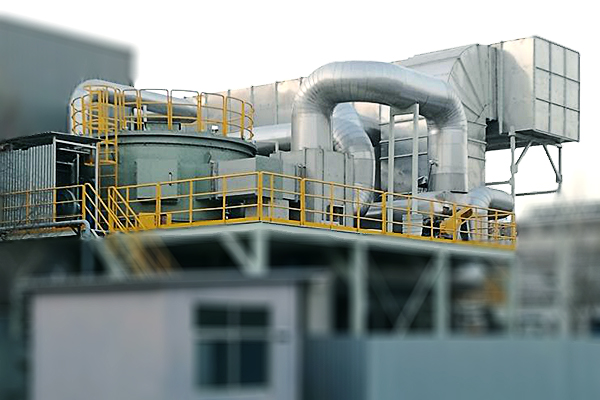
Designing effective pre-treatment requires matching each physicochemical principle to actual waste gas characteristics. Zhengzhou Puhua Technology specializes in complete treatment systems where pre-treatment, adsorption concentration, and catalytic combustion work as an integrated solution. The company provides engineering and manufacturing of bag filters for dust removal, zeolite rotary concentrators for humidity and VOC load leveling, and RCO/RTO catalytic combustion equipment designed with safety interlocks and heat recovery. Whether the application involves printing ink VOCs, coating line emissions, or chemical processing exhaust, properly engineered pre-treatment—based on the principles described above—ensures compliance, extends catalyst life, and reduces operating costs.
Conclusion
The pre-treatment requirements for catalytic combustion equipment are not arbitrary specifications but direct consequences of physical chemistry: catalyst surface site protection, adsorption isotherm optimization, boundary layer control, and thermal runaway prevention. By systematically removing particulates, adjusting temperature and humidity, and stabilizing VOC concentrations, facilities can achieve reliable performance. Consulting with experienced suppliers ensures that pre-treatment design matches the specific pollutant matrix, flow rate, and operating schedule of each unique industrial source.
Related Articles
-

Zeolite Fixed Bed+Catalytic Combustion Equipment (RCO)
[list:visits]
-

Resin desorption+condensation recovery equipment
[list:visits]
-

Cooking oil fume purifier
[list:visits]
Subscribe to Our Newsletter
Stay updated with the latest news and insights from Puhua Tech.