
Exhaust Gas Treatment Equipment Foundation Fabrication, Load, and Seismic Design Requirements

In the realm of industrial emission control, the focus is often placed squarely on the efficiency of the exhaust gas treatment equipment itself—scrubbers, catalytic oxidizers, or baghouse filters. However, the long-term reliability and safe operation of these systems are fundamentally rooted in what lies beneath and around them: the foundation and structural support. A well-designed foundation that accounts for static loads, dynamic forces, and seismic events is not merely a civil engineering detail; it is a critical prerequisite for achieving guaranteed emission compliance and operational continuity. This article provides a comprehensive overview of the key considerations for fabricating foundations for heavy pollution control equipment, focusing on load calculations and mandatory seismic design parameters.
1. Critical Factors in Foundation Fabrication
The fabrication of a foundation for systems like RTO equipment, large-scale exhaust gas treatment equipment, or a dust collector begins long before the concrete is poured. It requires a precise understanding of the equipment's operational profile and site-specific geological conditions.
Geotechnical Investigation: A thorough soil analysis is the first step. Bearing capacity, soil settlement characteristics, and groundwater levels dictate the foundation type—whether a shallow spread footing or deep pile foundation is required.
Equipment Mass and Center of Gravity: Large units like RCO catalytic combustion equipment and RTO equipment have a high center of gravity. The foundation must be designed with adequate overturning moment resistance, especially when subjected to wind or seismic lateral forces.
Anchorage and Embedment: Precision in setting anchor bolts is paramount. Misalignment here can render the entire system inoperable. Templates and careful survey control during the concrete pour are standard practices to ensure the equipment’s steel structure can be correctly mounted and leveled.
2. Comprehensive Load Analysis for Pollution Control Systems
A robust foundation design is predicated on an accurate assessment of all loads that will be imposed during the equipment's lifecycle. These loads are typically categorized as dead loads, live loads, and environmental loads, but for industrial VOCs organic waste gas treatment equipment, dynamic loads are equally critical.
2.1. Static Loads
These are the permanent, non-moving forces. They include the self-weight of the steel structure, the exhaust gas treatment equipment itself (e.g., a bag filter or desulfurization tower), and the weight of the process media (gas, liquid absorbents, or catalyst beds) when the system is in operation.
2.2. Dynamic and Operational Loads
Often underestimated, these loads can lead to fatigue failure of both the foundation and equipment connections if not properly accounted for.
Vibration: Systems such as pulse jet dust collectors and high-pressure fans generate constant, low-amplitude vibrations.
Impulse Loads: The operation of valves, dampers, and the pulse cleaning system on a baghouse dust collector creates cyclical impulse loads.
Thermal Expansion: Equipment operating at elevated temperatures, like RTO catalytic combustion equipment or RTO equipment, experiences thermal expansion. The foundation and support structure must accommodate this movement without inducing unacceptable stresses.
3. Seismic Design Requirements: A Non-Negotiable Standard
For facilities located in regions with seismic activity, the design of the foundation and support structure for exhaust gas treatment equipment must adhere to strict building codes (e.g., IBC, ASCE 7, or local Chinese seismic codes). The goal is to ensure that the pollution control system remains structurally sound and functional after a seismic event to prevent hazardous material release.
Key seismic design considerations include:
Importance Factor: Pollution control systems are often classified as critical components (Risk Category III or IV) because their failure could lead to environmental contamination. This classification results in a higher seismic design force requirement.
Redundancy and Ductility: The structural system supporting VOCs organic waste gas treatment equipment should be designed with ductile details, allowing it to absorb and dissipate seismic energy through controlled deformation rather than brittle failure.
Non-Structural Component Anchorage: This includes all piping, ductwork, and electrical conduits. Seismic restraints, such as sway bracing, must be installed to prevent these components from becoming projectiles or causing secondary damage during an earthquake.
The following table summarizes the relationship between equipment type, primary load concerns, and seismic risk factors.
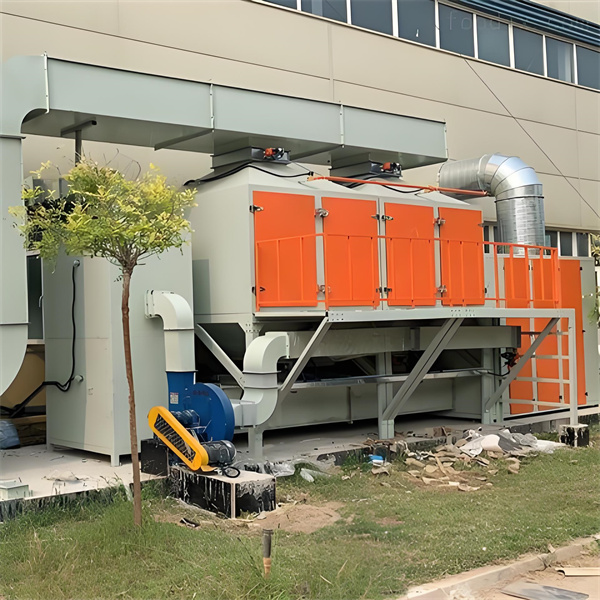
| Equipment Type | Primary Load Concerns | Seismic Risk Factors | Critical Design Detail |
|---|---|---|---|
| RTO / RCO Catalytic Combustion Equipment | High static mass, thermal expansion, valve impulse loads | High center of gravity, rigid interconnecting piping | Slotted connections for thermal movement, reinforced anchorage |
| Large Baghouse Dust Collector | High static mass, pulse jet impulse loads, fan vibration | Large plan area, potential for differential settlement | Continuous grade beam foundation, vibration isolation pads |
| Desulfurization Tower / Scrubber | High static mass, liquid sloshing, corrosion potential | Slender structure, high aspect ratio | Deep pile foundation to resist overturning, corrosion-resistant steel embedment |
| VOCs Organic Waste Gas Treatment Equipment (Skid-mounted) | Concentrated point loads from skid, dynamic fan loads | Equipment skid can slide or overturn | Oversized anchor bolts with shear lugs, seismic snubbers |
4. Professional Practice: Integrating Expertise in Design and Fabrication
Successfully navigating the complexities of foundation fabrication, load analysis, and seismic compliance requires a collaborative approach between process engineers, structural engineers, and experienced equipment manufacturers. A manufacturer with deep expertise understands not only the process chemistry but also the structural demands of their equipment. For instance, when specifying a system like a bag filter or desulfurization equipment, engaging with a provider that considers these foundational aspects from the outset is crucial.
Zhengzhou Puhua Technology, a recognized environmental protection equipment manufacturer in Henan, specializes in the design and research & development of a comprehensive range of pollution control solutions. Their portfolio includes dust collectors, desulfurization equipment, denitrification equipment, VOCs organic waste gas treatment equipment, pneumatic conveying systems, and wastewater treatment equipment. Their product line—featuring baghouse dust collectors, RCO catalytic combustion equipment, RTO equipment, desulfurization towers, and ultra-low emission systems—is engineered for robust performance, a principle that extends to understanding the critical interface between the equipment and its supporting structure. By integrating structural considerations early in the project lifecycle, they help ensure that the foundation fabrication aligns perfectly with the equipment's operational and safety requirements.
Conclusion: Building on a Solid Foundation
The foundation for exhaust gas treatment equipment is more than just a concrete pad; it is a critical structural system that ensures safety, operational reliability, and long-term compliance. A thorough approach that includes a detailed geotechnical investigation, precise static and dynamic load analysis, and strict adherence to seismic design codes is essential. For project engineers and plant managers, prioritizing these foundational elements during the planning phase mitigates risk, reduces lifecycle maintenance costs, and guarantees that the pollution control system can withstand not only its daily operational demands but also the forces of nature.
Keywords: exhaust gas treatment equipment foundation, seismic design for pollution control, dust collector load analysis, RTO equipment support structure
Related Articles
-

Zeolite Fixed Bed+Catalytic Combustion Equipment (RCO)
[list:visits]
-

Resin desorption+condensation recovery equipment
[list:visits]
-

Cooking oil fume purifier
[list:visits]
Subscribe to Our Newsletter
Stay updated with the latest news and insights from Puhua Tech.