
Cement Grinding Station Retrofit: Replacing Traditional Baghouses with Cartridge Dust Collectors

In the cement industry, I have spent the better part of two decades focused on one thing: particulate matter control. I have walked through scores of grinding stations, and a familiar scene is playing out across the industry. Plant managers stand next to their aging pulse-jet baghouses, watching the differential pressure gauge creep higher and higher. The conversation usually starts the same way: "Our old baghouse just can't keep up with the new emission standards, and the power bill is killing us. What are our options?"
This is the exact predicament many facilities face today. Traditional baghouses, once the workhorses of cement dust collection, are showing their age under the pressure of stricter environmental regulations and increased production demands. Issues like bag blinding, high maintenance costs, and inability to achieve ultra-low emissions have become significant operational headaches. This article explores a viable solution through a detailed retrofit case study: replacing a conventional baghouse with a high-efficiency cartridge dust collector.
The Challenge: A Case of Declining Efficiency at an Old Grinding Station
Let's look at a real-world scenario. A cement grinding station in Hebei province, operating for nearly a decade, relied on a standard pulse-jet baghouse for its mill ventilation and transport points. For years, it managed to keep emissions around 20-30 mg/Nm³. However, as time took its toll, the plant began to experience what I call the "baghouse death spiral."
Rising Differential Pressure: The permeability of the polyester filter bags decreased due to cement dust impregnation and "blinding," causing the system resistance to soar. The static pressure regularly exceeded 1800-2000 Pa .
Soaring Energy Consumption: To overcome this high resistance, the induced draft fan had to run at maximum frequency, consuming significantly more power just to maintain the required capture velocity at the pick-up points.
Frequent and Costly Maintenance: Filter bags were prone to abrasion and required replacement every 6-12 months. Each change-out was a labor-intensive process, requiring confined space entry and significant downtime .
Inconsistent Emissions: The plant struggled to consistently meet the local ultra-low emission standards, often spiking above the desired limit of 10 mg/Nm³ during cleaning cycles or production fluctuations.
The plant needed a solution that would not only guarantee compliance but also improve their operational efficiency. Simply replacing the bags was no longer a viable option; a fundamental technology upgrade was required.
The Proposed Solution: A Retrofit with Cartridge Technology
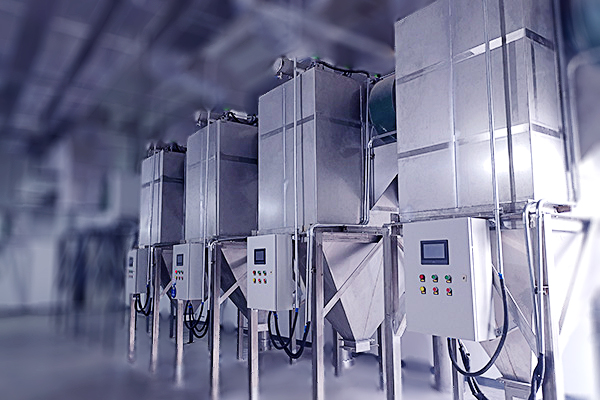
After a thorough on-site audit and analysis of the gas volume and dust characteristics, we proposed a comprehensive retrofit plan centered on replacing the existing bag filtration system with a cartridge dust collector. The goal was not just a filter swap, but a complete system optimization. The team at Zhengzhou Puhua Technology, a leading manufacturer of environmental equipment in Henan, provided the engineering expertise and core technology for this transformation.
The retrofit process focused on three critical modifications:
Tube Sheet Modification & Cartridge Integration: The original tube sheet was designed for long, cylindrical bags. We removed the old hardware and installed a new, precision-engineered tube sheet compatible with a vertical cartridge configuration. This allowed us to increase the total filtration area by nearly 40% within the same physical footprint of the existing housing .
Advanced Pleated Filter Media: We installed 20 pleated filter cartridges per unit, each featuring a 100% synthetic spunbound media with an ePTFE membrane . This membrane technology is crucial for cement applications as it provides superior surface loading, meaning dust sits on the surface of the media rather than embedding deep within it. This characteristic is key to achieving stable, low-pressure drop operation.
High-Pressure Pulse-Jet Cleaning System Upgrade: The old cleaning system was underpowered for the fine, sticky nature of cement dust. We replaced it with a high-pressure pulse-jet system featuring larger 3-inch pulse valves and precision nozzles. This upgrade ensures a powerful, evenly distributed burst of compressed air that effectively cleans the pleated cartridges, maintaining low differential pressure over time .
This entire retrofit was executed during a scheduled maintenance shutdown and completed in under one week, from equipment removal to commissioning, minimizing production interruption.
Comparative Analysis: Before and After the Cartridge Retrofit
The results of the retrofit were monitored closely over the following six months. The improvements were dramatic and immediate, clearly demonstrating the superiority of the cartridge system for this application.
| Parameter | Before (Traditional Baghouse) | After (Cartridge Retrofit) |
|---|---|---|
| Filter Media Type | Standard Polyester Felt Bags | Pleated Cartridge with ePTFE Membrane |
| Total Filtration Area | 5,090 m² (baseline) | 9,100 m² (+79% increase) |
| Outlet Emission Concentration | 20 - 30 mg/Nm³ | Consistently < 8 mg/Nm³ |
| System Differential Pressure | ~1800 - 2000 Pa | ~1000 - 1200 Pa |
| Fan Motor Current | High / Near Capacity | ~15% Reduction in Energy Consumption |
| Maintenance Frequency | Bag replacement every ~6-12 months | Cartridges performing well after 24+ months |
Why Cartridge Collectors Prevail in This Application
This case study highlights several distinct advantages of using a cartridge dust collector in a cement grinding station retrofit:
Higher Efficiency in a Smaller Footprint: The pleated design packs significantly more media into the same space, allowing for increased production capacity without expanding the building.
Stable, Low Emissions: The ePTFE membrane provides consistent filtration efficiency, reliably meeting and exceeding ultra-low emission standards.
Energy Savings: The lower differential pressure directly translates to reduced fan power consumption, offering a compelling return on investment.
Simplified Maintenance: Cartridges are typically easier and safer to replace than traditional bags and cages, reducing labor costs and downtime .
While bag filters remain a viable option for extremely high-temperature applications or very coarse dust loads, for the vast majority of cement grinding applications—including mill vents, transfer points, and silo vents—the cartridge collector represents a superior technological choice .
Selecting the Right Partner for Your Dust Control Project
Executing a successful retrofit requires more than just purchasing new equipment; it demands engineering know-how and a deep understanding of the specific application. The team at Zhengzhou Puhua Technology brings this expertise to the table. With a comprehensive portfolio that includes pulse-jet cartridge collectors, baghouses, and advanced solutions for ultra-low emissions, they are well-equipped to design and manufacture systems that meet the rigorous demands of the cement industry. Their approach focuses on customizing solutions—whether for dust collection, gas scrubbing, or material handling—to ensure each client achieves optimal performance and regulatory compliance.
If your grinding station is grappling with high energy costs or struggling to meet emission limits, a cartridge retrofit could be the strategic upgrade your operation needs. The data from this and similar projects confirms it is an investment that pays for itself in energy savings and peace of mind.
Related Articles
-

Zeolite Fixed Bed+Catalytic Combustion Equipment (RCO)
[list:visits]
-

Resin desorption+condensation recovery equipment
[list:visits]
-

Cooking oil fume purifier
[list:visits]
Subscribe to Our Newsletter
Stay updated with the latest news and insights from Puhua Tech.